

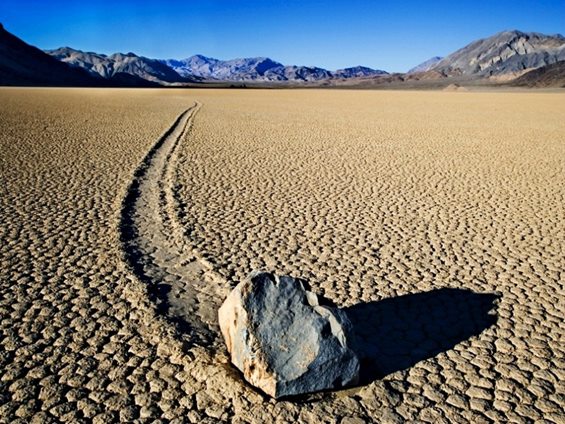
In the middle of Death Valley, one of the driest, hottest places on Earth, enormous rocks glide silently across a dry lakebed as if pulled by invisible hands. They leave behind long, winding tracks etched into the cracked desert floor, some stretching hundreds of feet. The scene looks less like geology and more like a prank from the universe. For decades, scientists, adventurers, and skeptics have stood in Racetrack Playa and asked the same question: how on earth do the stones move?
A Mystery That Refused to Sit Still
The first reports date back to the early 1900s, when prospectors stumbled onto the playa and noticed massive stones sitting at the ends of trails carved into the earth. There were no footprints, no machinery tracks, nothing to explain the movement. Just rocks that seemed to have gone for a stroll.
For much of the twentieth century, explanations ranged from the serious to the absurd. Some suggested hurricane-force winds could push the rocks across the playa. Others leaned on aliens, ghosts, or magnetic fields. Hikers and tourists whispered theories about pranks — as if someone had dragged half-ton boulders across the desert for fun.
The mystery persisted because nobody had ever caught the stones in the act. No one had seen them move. And so the sailing stones became a natural riddle — a real-world X-file.
Science Finally Catches Up
It wasn’t until 2014 that researchers finally cracked the case with cameras, GPS trackers, and a lot of patience. They discovered that in the rare winters when rain falls on Death Valley, a thin sheet of water pools on the playa. Overnight, that water can freeze, forming large, thin sheets of ice.

As the sun rises, the ice begins to melt and break apart into massive floating panels. When a breeze kicks up — nothing dramatic, just a steady push — those ice panels act like sails, nudging even the heaviest rocks across the slick mud beneath. The result? Slow, steady movement that leaves behind those long, eerie trails.
What looks like magic is really a perfect alignment of conditions: water, freezing nights, thawing mornings, and just the right amount of wind. Most of the time, Death Valley is too hot, too dry, or too still. But every once in a while, nature sets the stage, and the stones glide.
Why the Fascination Persists
If you’re disappointed that the answer isn’t aliens or desert spirits, think again. The real explanation is even stranger in its own way. For these giant rocks to move, dozens of variables have to line up in a place famous for extreme conditions. It’s like nature choreographed a secret ballet — one that almost nobody gets to see in person.
That’s part of the allure. We love mysteries that remind us the world is still bigger, stranger, and more complicated than our day-to-day lives suggest. Even when science solves them, the wonder doesn’t vanish. If anything, the details — ice sheets breaking under the sun, stones drifting on a desert lake that shouldn’t even exist — make the story richer.
The sailing stones are a reminder that mystery doesn’t always need a supernatural answer to stay magical. Sometimes, the truth is just as dazzling as the legend. We’re fascinated because they embody two human cravings at once: the need to explain and the need to wonder.
So the next time you find yourself in Death Valley, staring at a rock with a long track behind it, don’t think of it as “just geology.” Think of it as a reminder that even in a world mapped by satellites and explained by science, there are still moments when the Earth feels alive, playful, and full of secrets.